
.png)


Our Commitment to lasting relationships.
With the addition of a propagation license in 2025, we are excited to face the challenge set out in the states guidance, complete transparency for our partners in retail, Cultivators, and Home growers.
Our high THC Cannabis Products are only available through Vermont Dispensaries.
Read more about our approach to clean seed including HLVd, and IPM protocol with the links provided.
Cannabinoid Analysis


Terpene Analysis


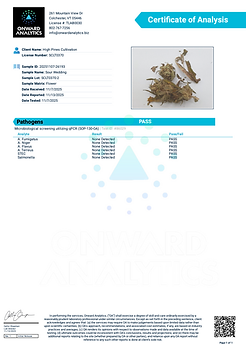
Pesticide and Pathogen Certificates




Our Approach To Clean Cannabis Seed
We are committed to the integrity of our cannabis genetics. To that end, we implement rigorous testing protocols designed to detect Hop Latent Viroid (HLVd) at every stage of our cultivation and breeding process. We understand the importance of providing clean, healthy genetics, and we take all necessary precautions to uphold those standards.
Firstly, all plant material used for breeding, seed, or clone stock will be tested for HLVd (Hop Latent Viroid) before entering propagation space. Either through out of state testing to ensure compliance, or instate testing to confirm compliance. See our blog for more information on HLVd. New clones and seeds will be germinated and selected from in a controlled space. When selecting phenotypes from large populations in the greenhouse we take measures to not spread any potential disease or pest by keeping tools, trays, pots and hands clean. Regular Pest Management Protocols will be employed only if needed. Namely topical applications of Sulphur, or Safer Soap. We apply organic, regenerative, and sustainable practices whenever possible.
Cleanliness is a priority. We have a 10x10 space dedicated to entirely to inspecting, cleaning and propagating plantlets. Micropropigation in this space will allow us to store and divide plants in a completely sterile work environment. This eliminates the threat of spreading virus, pests, and microbes on our farm. And with clean starting material, it is much easier to keep plants clean as they are transplanted into soil and eventually into the greenhouse. In a short period we should be able mitigate risk of exposure to unwanted pests and pathogens by a considerable degree.
Further, we hope to develop a protocol for isolating meristem culture to clean plant material potentially infected by virus. Offering this service to others would be a great step to combatting the spread of HLVd in the community.
All seed then developed from clean plant selections will yield virus free plants.